
The most consistent pushback I get when presenting my case for systemic design is against the idea that authorial games are not as interactive as more emergent games.
“They surely are interactive,” says the typical critic, “because you are pressing buttons; there’s gameplay.” Which is true at face value, since you are certainly pressing buttons and there definitely is gameplay. But pressing buttons or shooting virtual guns is not necessarily the same as interactivity.
Interactivity as the act of interacting is not enough. It must also generate relevant feedback and put the player into positions where they must choose one thing over another. Sid Meier’s comment on games being “a series of meaningful choices” comes in here. Pushing forward to progress to the next room or set piece is not a choice.
In this post I’ll try to elaborate on this line of argument. You don’t have to agree at the end of course, since game design is ultimately subjective, but you will hopefully understand where I’m coming from and how this fits into the dichotomy between authorship and emergence. Maybe you’ll also want to join me in dreaming of what games can be capable of on the interaction frontier.
If you do disagree, please do so in comments or to annander@gmail.com. The best conversations happen when we see things differently.
Interactivity
Games receive input that is transformed into output. If that output is a digital beep, a 2D sprite initiating a jumping animation, or a dice roll coming up a five, depends on the game and its interface. Interactivity is the common ground that separates games and play from other forms of media. How much interactivity we’re talking about and at which point in the game varies between games.
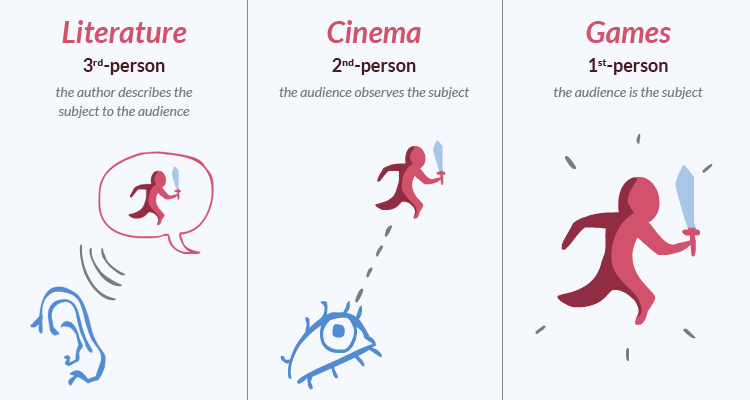
Fortunately, someone else has already phrased the larger framework more succinctly than I can. In Hitbox Team’s excellent article on game narrative, Terence Lee argues that storytelling can be broadly classified into three dimensions.
The first dimension is time. A novel is a story where you must read the second word after the first, and even if your imagination can turn a time-locked story into anything, and the story itself may tell its tale in countless disjointed or anachronistic ways, time is the only dimension it’s reliant on. It is a form of observation where you take part in whatever the creator is relaying to you through your imagination.
When you bring in other senses, such as your hearing and vision, you are adding this to the dimension of time. You get movies and theater. It’s a more passive observation than a novel that leaves everything to your imagination, but it expands the author’s control over time to also control your senses. It’s fundamentally its own thing. Telling stories with moving pictures and sound adds more considerations and tools to the storyteller’s toolbox.
Then we add interactivity. You are no longer a passive observer but a participant. Your actions are now those of a character in the story. Authorship comes in here with restrictions on what you can do as a participant. “It diminishes the importance of your actions,” writes Terence Lee of Hitbox Team, “if it feels like the game distrusts you with making the important ones.” For example when the third dimension is removed to show you a cutscene of how the protagonist defeats the antagonist after you whittled away its hit points in a ten-minute bossfight.
This, my friends, is where this argument takes off: finding the important actions and the interesting choices.
Game Feel
How it feels to play a game is sometimes referred to as game feel. In Steve Swink’s book named the same, six elements that affect this are Input, Response, Context, Rules, Polish, and Metaphor.
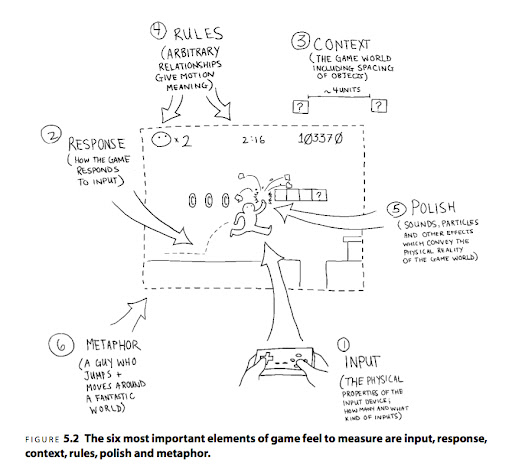
- Physical input. You press a button, roll a die, or whatever you do.
- A response to your interaction. From haptics on to witty barks, something will (or at least should) signal that the input was received.
- The context of the game. Standing on flat ground allows the button to trigger a jump, for example.
- Rules. How many extra lives, how much time you have, how gravity works and so on are applied to the now contextualized input.
- Polish. Fleshes out the aural and visual experience and make it as clear and/or rewarding as possible what’s happening. This is separate from the response, because this is part of the game simulation and may therefore happen with some delay.
- Metaphors of the virtual space. A character, the verb of jumping, etc. The piece of presentation that makes it all make sense to the player.
If we consider these six components relevant to how it feels to play a game, and we look at them as the key essentials of interactivity, we begin to see which actions can be considered important.
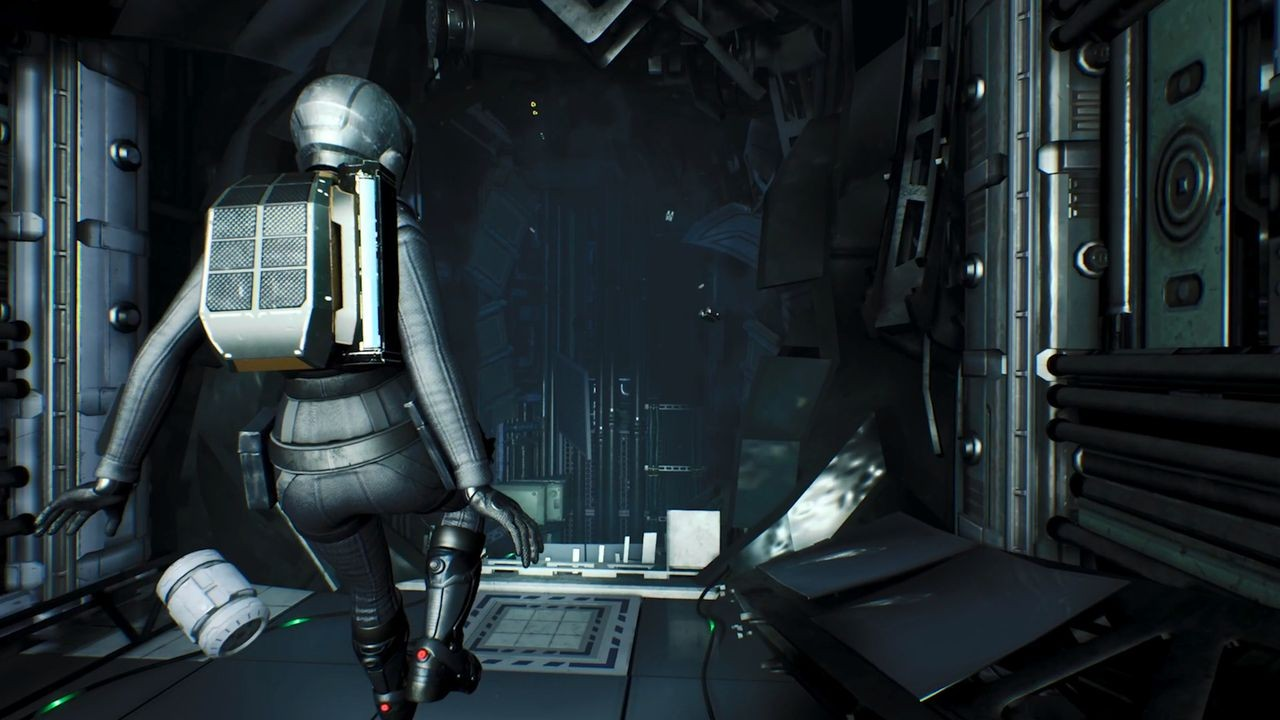
When the inimitable Josef Fares animatedly tells you that you never do the same thing twice in A Way Out, a jaded game designer like myself only sees the left analogue stick pressed forward but with 100s of animations on top. Crawling through a vent. Walking across the yard. Running from the guards. The first four of Swink’s game feel elements (input, response, context, and rules) do not change between these activities.
In a highly authored game, such as A Way Out, I can’t always know what the context means, which rules are currently in effect, or even what the response will be. There is a higher focus on metaphor and polish: I’m following the characters on the screen as an observer and not as a participant. I’m watching what they do: I have not become them.
There’s typically a specific outcome that has to be the result of the scene, such as the characters managing to steal something from a locked office. There may be some different routes to this that provide different visual feedback, different animations, but fundamentally it’s a cinematic experience. There’s also no way for me to fail and the story to adapt to my failure. If I do fail, the game state will reset and I’ll have to try again until I succeed.
Empathetic Connections
Focus on polish and metaphor is not by accident. As Nicole Lazzaro has said, “[F]ilm and cinema, they can’t do a lot of emotions because it’s simply an empathetic thing. […] The format doesn’t allow certain emotions nearly as well as games.”
Movie makers are experts of empathy. Creating and managing empathetic bonds between a viewer and an on-screen actor playing a role. If there would suddenly be instances where context or rules could subvert this polished outcome, for example because the viewer could switch out the soundtrack or skip a crucial piece of dialogue, it would ruin this precisely crafted connection. This is why they are not invited into the interaction, and why most of Swink’s elements are removed from games that strive for empathy.
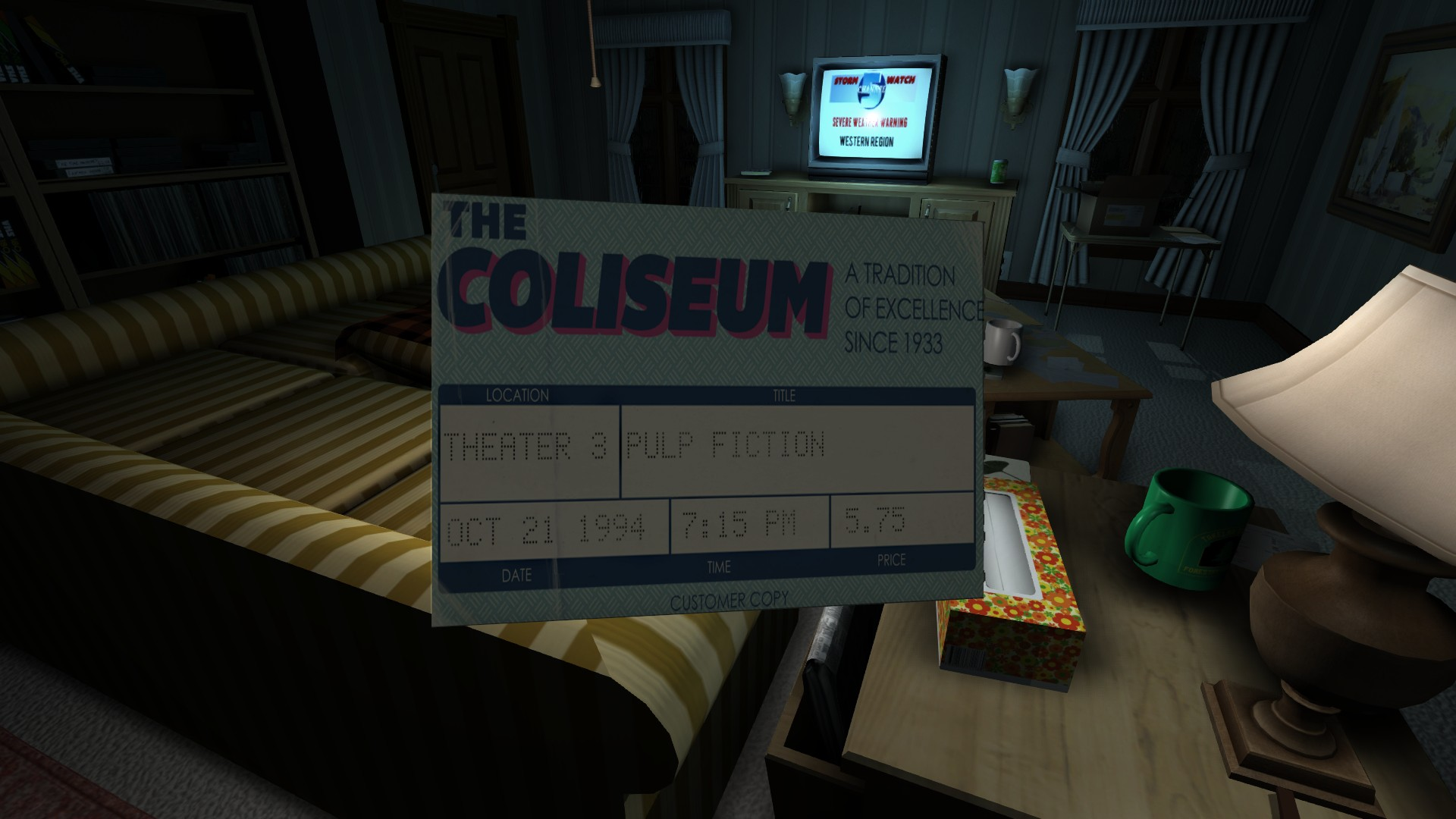
This isn’t only clear in animation-heavy games that are closely directed, such as the games by Josef Fares. Similarly, Ian Bogost describes the protagonist of Gone Home as “a cursor you move to experience the story.” You are certainly controlling the input in that game: pressing forward, choosing which objects to interact with, which audio logs to listen to, and then gradually piecing the story together in your head. But you are not there to participate. The game is designed to make you empathize, not with the character you are playing, but the one game is telling you about.
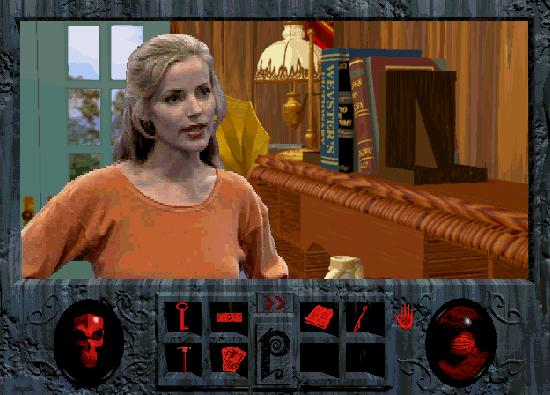
This is functionally the same as point-and-click adventures in the later style. Games like Phantasmagoria, that attempted to simplify the interaction and minimize the style of feedback that those games were known for in favor of telling its story in a more cinematic fashion. To focus on spectacle, gore, even disgust, as empathetic emotions based on what the main character is forced to endure.
The main character of Phantasmagoria doesn’t say “won’t budge” about the door, but will instead fidget with the handle for a while in an animation before giving up. Something that felt detailed and potentially empathetic for players of the seven-CD horror adventure on release, but seems dated and almost comical when you play it today. Today, you want her to fiddle faster so you can keep playing. Also, few film makers would spend 30 precious seconds having an expensive actor fidget with a door handle. So rather than adding quality, it feels cheap. Like a bad interpretation of a movie more than an actual movie.
As another example, the same empathetic connection exists between the player and Joel’s daughter Sarah in the intro to The Last of Us. Functionally, she’s also just a cursor for activating sound bites and cutscenes in the environment until the story moves on outside of your control. My personal opinion is that the Sarah segment is meaningless as interactivity, and strongly exemplifies said empathy. We may care about Sarah because we are told that Joel cares about Sarah, and having her visually represented and voiced as a real character tells us that she is something more than a sad plot device once the next few plot beats takes her away.
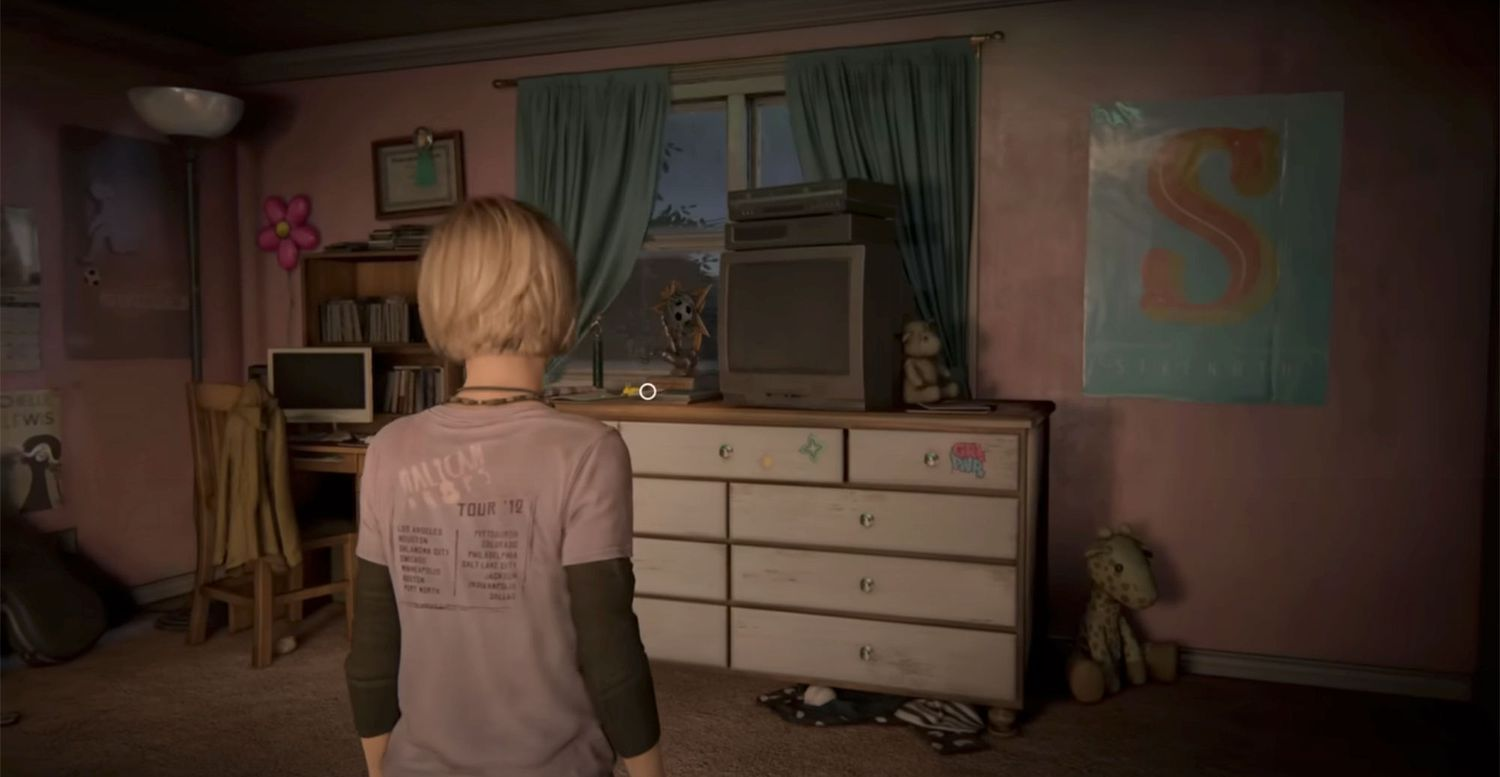
In essence, we are told to care about Sarah, the same way a movie would tell us to care. But we have no choice in the matter and most of Swink’s elements and Meier’s golden rule are once more removed. There are no meaningful choices to be made when we are only moving a story cursor across a virtual space. In fact, and this is where the critics will usually jump in, other types of storytelling do empathy better than games, meaning that we don’t gain anything by turning these experiences into games. To approach empathy this way, games must restrict the impact of our interactions, and the only actions we get to do are the ones that can be safely stripped of meaning so that we, as players, can’t ruin the authored experience.
Murdering the Innocent
In an interview with Introversion’s Chris DeLay, he mentions a study where playing their game DEFCON—a game about global nuclear war—had a deeper impact on survey respondents than watching a documentary on the same topic. A result that implies the effects of interactivity on an emotional level.
Even by controlling Sarah, we may gain something from pushing forward even when our actions have limited meaning. But we can learn and feel more about something if we add elements from Swink’s game feel.
In gaming, we do have some darlings that often come up as examples of interactive storytelling. People will mention the plot twist in BioShock: would you kindly? Unfortunately, all this particular twist does is that it rubs our noses in the fact that we have no choice. It’s like making a point of how little interaction we have.
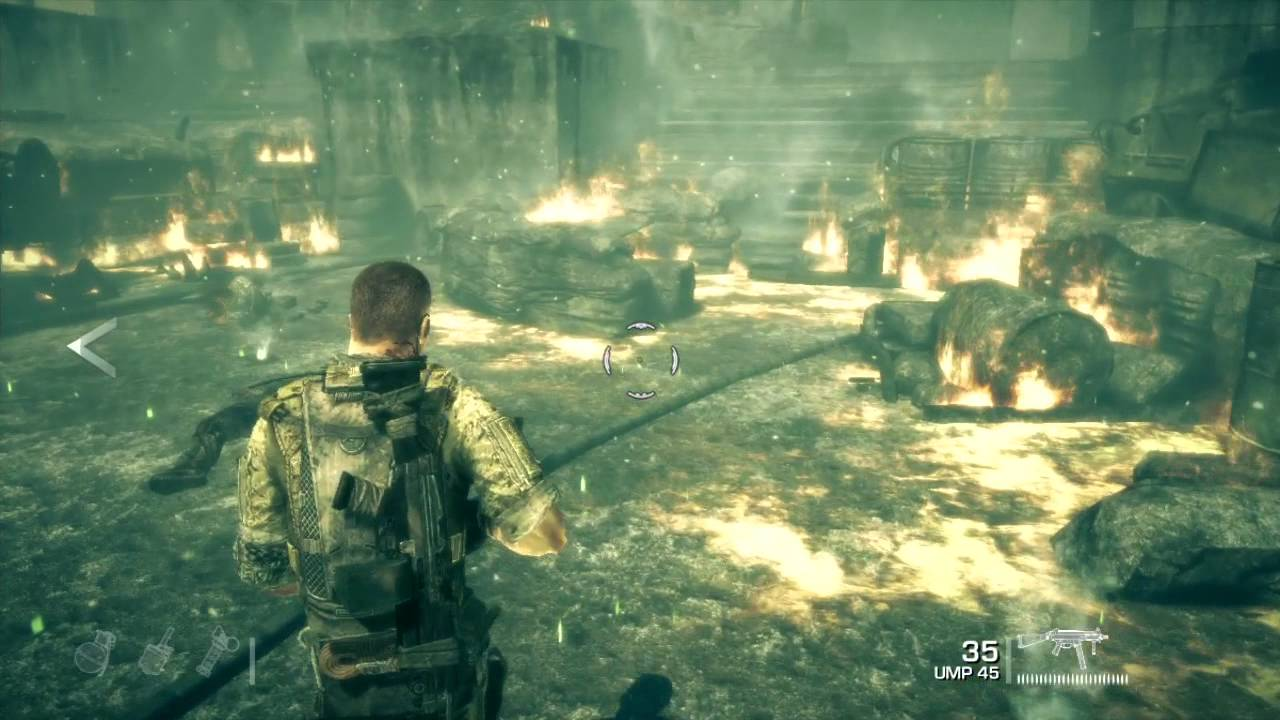
Another darling is Spec Ops: The Line. A game that asks you to commit war crimes and then rubs your nose in it in a similar way. Push the button, then we’ll make you feel bad for having pushed it. It’s pulled off in a better way than in BioShock (in my opinion) but still suffers from the same problems. I’m in for the ride already. I bought the game. Pushing the button is just a way to see if I will get a snack, like a rat in a Skinner box. It doesn’t make me complicit to anything where I can’t predict or at least understand the outcome.
But now this post has already devalued the game story darlings of the past decade and set my e-mail up for more pushback. There must be some point to make. Some reason that interactivity is worth having even for game developers that lean more heavily towards authorship. So far, it seems to argue for authorship, since authored stories demonstrably do empathy so much better.
To get a good example, let’s look at a board game that engages so deeply with its theme that it has courted real controversy. The game is John Company, by game designer Cole Wehrle, and it puts players in the shoes of family leaders trying their best to make money off the British East India Company. The game’s rulebook is illustrated with contemporary political satire, and the role you play and the actions you take are deeply exploitative and imperialistic. An interpretation through gameplay of what the real East India Company did to the peoples it oppressed. An interactive illustration of British imperialism at its height and how the British museum’s most precious Indian artifacts landed in its collections.
Not only does this game ask you to do heinous acts and reward you for them, it turns the vying for power and the exploitation itself into a game. The suffering is made abstract and turned into an inconvenience, while you try to maximize your gains and save up enough money to put your family members into the nicest retirement homes.
Some will of course say “it’s just a game.” This is always a bad take. John Company demonstrates how interactivity matters. Similarly to BioShock and Spec Ops: The Line, I can’t choose to be a good person and not engage in imperialism, of course. But by acting within the confines of the game’s premise and abstractions I will realise that the game I’m playing is probably quite similar to the game that was played above the heads of the oppressed.
It becomes more than “just a game.” It becomes experiential. Entirely thanks to interesting choices and interactivity.

Medial Regression
You are free to enjoy well-produced empathetic games. There’s nothing wrong with such games and there never will be. Developers should keep making them, and we’ll all keep playing them.
But the last point of this post is that they also don’t develop the art form of games. To be able to focus on empathy, they need to step back from the third dimension into the second one. They need to regress into linear media and disallow or restrict interactivity to some extent. This is what medial regression means: to put away the unique elements of your medium in favor of those of another medium.
Some players want exactly this and expect it. They want to be able to skip the gameplay moments so they can keep learning about the characters and building their relationships, and they enjoy non-interactive cutscenes for any of a number of reasons. This is okay. Too often, gameplay only means fail states or time sinks. Things that can feel like they’re obstacles to your enjoyment of the virtual world you’re engaged with.
Somehow, we’re less okay with medial regression for other types of media. Since movies have had a century to develop their own language, from cinematography to acting techniques, we look at a movie that becomes more theatrical as medial regression too. We notice the somewhat stilted and more clearly articulated manner of stage speech and may even resort to calling it “bad acting.”
If movies had never added audio, they could still be great silent films, but they would also never have explored how audio or soundtrack affects storytelling. Likewise, making our games cinematic and limiting interactivity so that our games can lead with empathy will never explore our own medium’s core strengths. It will never force us to develop our own tools for making the most of interactivity.
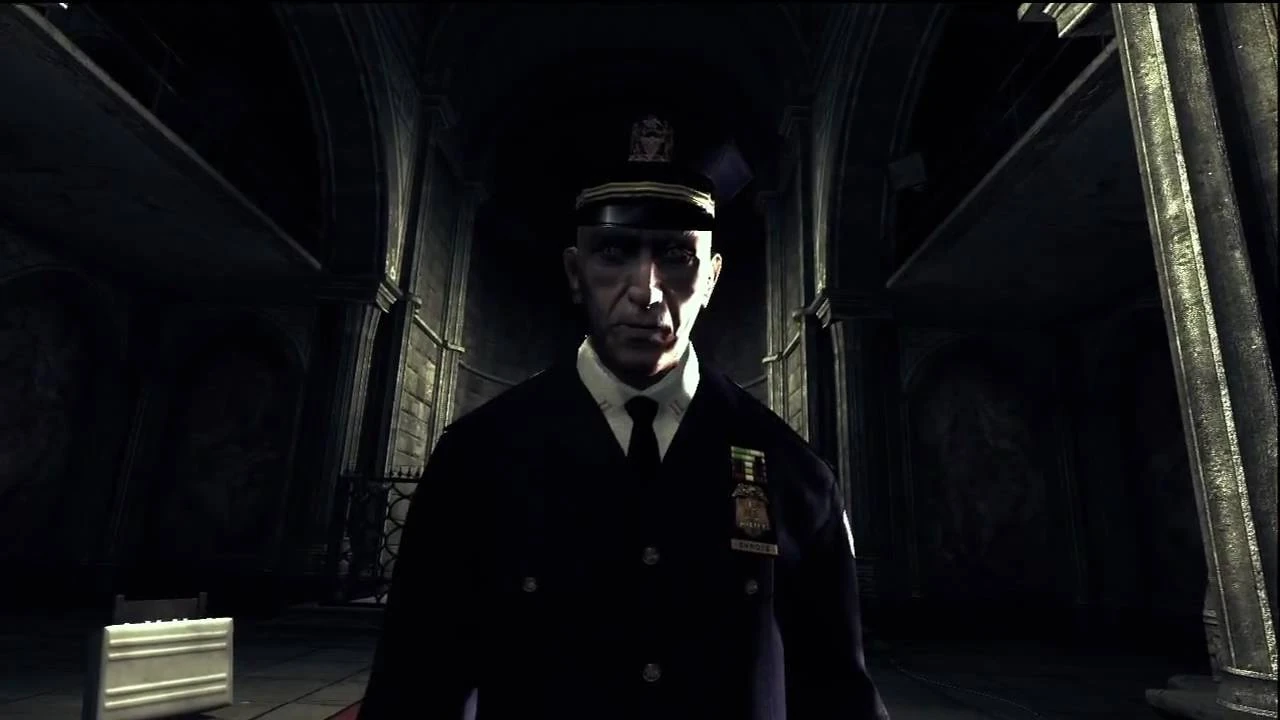
Medial regression puts us in a place where we no longer push our art form forward. It allows us to comfortably keep using methods from other art forms, without having to discover our own. It also easily transfers the mindsets of other media production into game development, even though game development is a deeply collaborative and iterative. We don’t benefit from auteur directors and we don’t treat production the same as film. A culture clash occurs, even beyond the product.
Like how Randy Smith described the culture of venerable game studio Looking Glass. “There were various individual superheroes,” he said. “Terri Brosius, Dan Thron, Doug Church, Mark LeBlanc. But somehow, the goal wasn’t to be like, ‘I’m Mark LeBlanc who made this system in the game, and everybody knows me’. You were measured against the game we all created together. The game’s as good as its weakest link. Ego wasn’t the focus.”
To get that kind of magic, you can’t have auteur directors and you must push for the thing that makes video games unique. When we actively do so, it leads us towards a more interesting future where we are better acquainted with the tools we use because we have made them for ourselves.
The Interaction Frontier
When discussing first-person cameras, CD Projekt Red’s research for Cyberpunk 2077 was brought up as an excellent first step in blending lessons we can learn from cinema with the unique needs of video games. Some of the questions that need to be answered, such as how to keep the player’s attention and making sure they get to experience interesting things, are questions that are guaranteed to have even more answers that we haven’t even discovered yet. This is what should be the real goal: figuring out how to factor interactivity into everything we do.
How a game like What Remains of Edith Finch lets you experience the horrifying fates of the Finch family members through playful yet morbid mini-games helps us understand what video games can do. Not because we are told about it or asked to empathise, but because we are ourselves living a part of the experience through gameplay. Sometimes whimsical, sometimes repetitive, always thought-provoking.
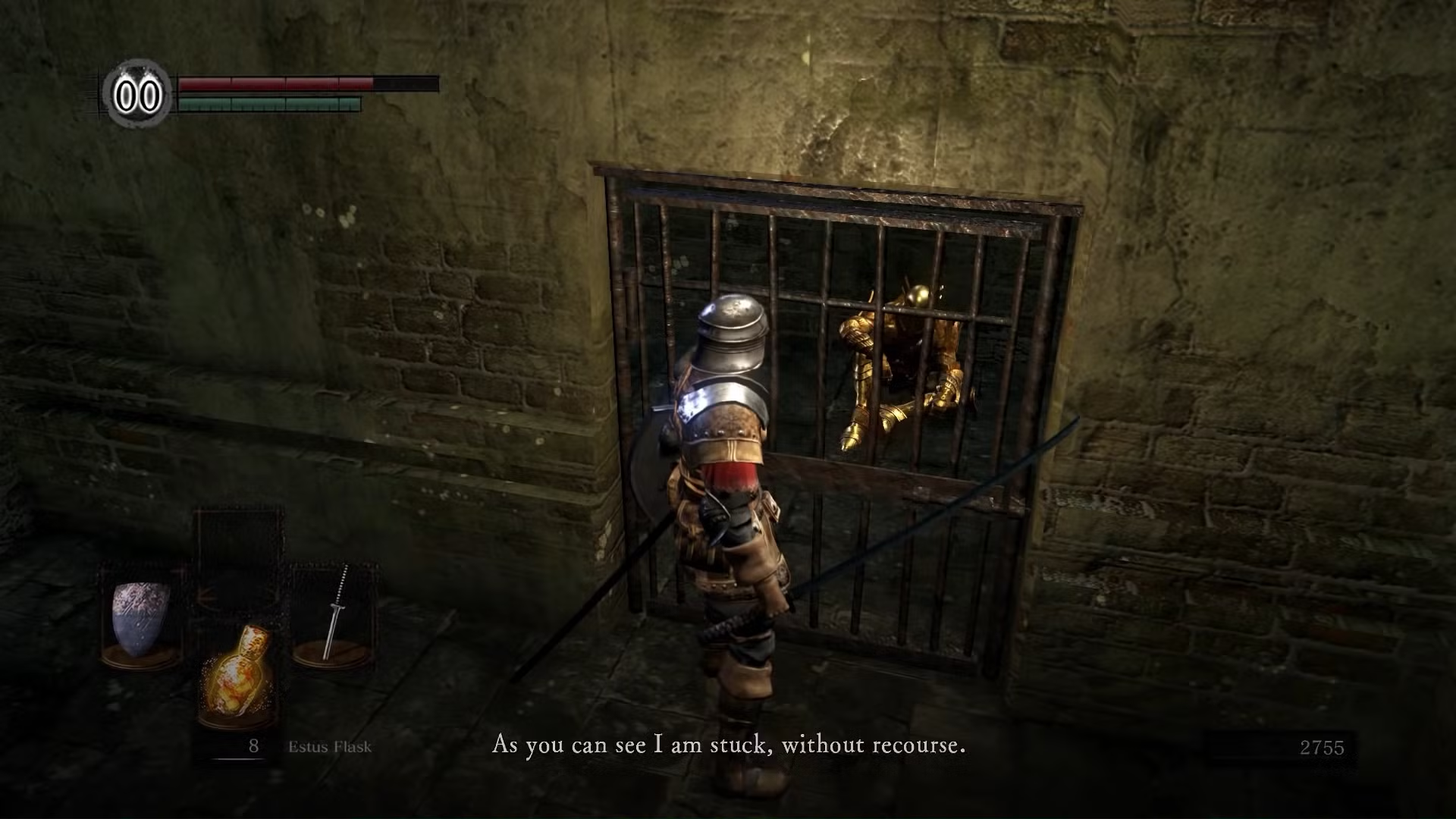
The way Dark Souls handles its non-player characters explores the concept of consequences. If you kill the blacksmith, the blacksmith is indeed dead. You’re not guarded from doing bad deeds and the systems of the game are consistently applied. The experience is yours to own. Similarly, if you choose to rescue Lautrec and leave him near the Firelink shrine, he will kill the keeper of that shrine later. A consequence that blew my mind on my first playthrough simply because games never do that. Betrayal is almost always clearly advertised in games. Yet here was a game where story was implied and never explicit, and there was no way to save scum my way to the “best” ending. What happened was predefined, but the circumstances were for me to figure out. No director in sight.
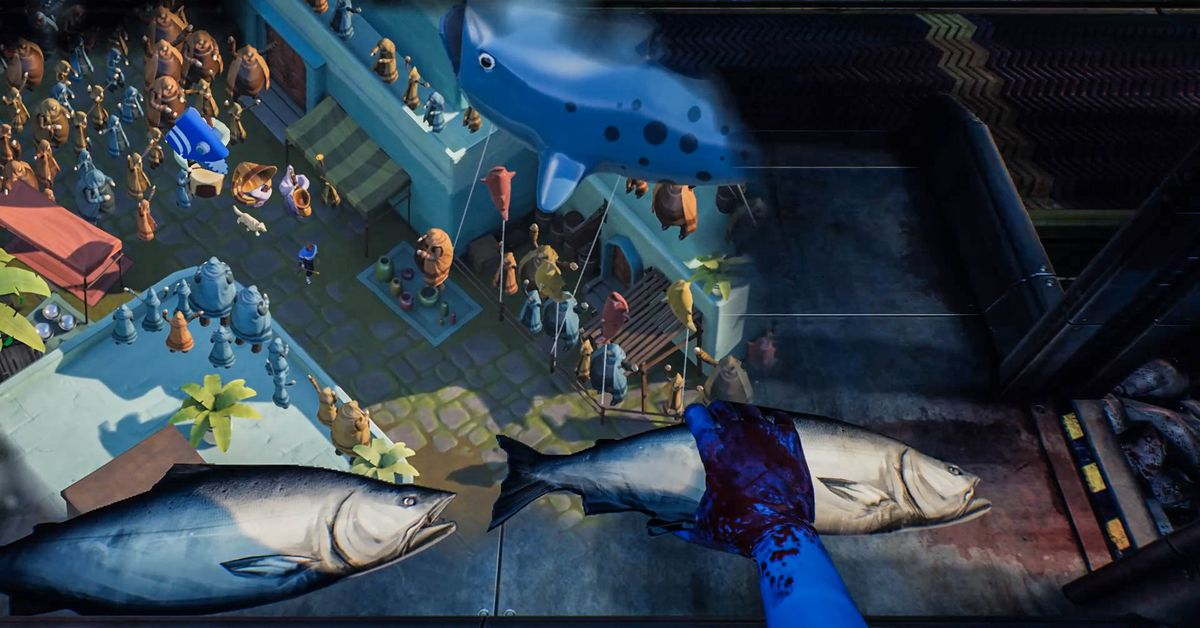
With Outer Wilds, the way the game handles the player’s own knowledge of the game space as a form of progression could only happen with a game. A small repeating cycle of events that you can interact with and that you must learn to interact with in the right order to be successful. There isn’t even a clear way initially to understand how things end. You are given tools and a dilemma, and then let loose to figure out what it all means.

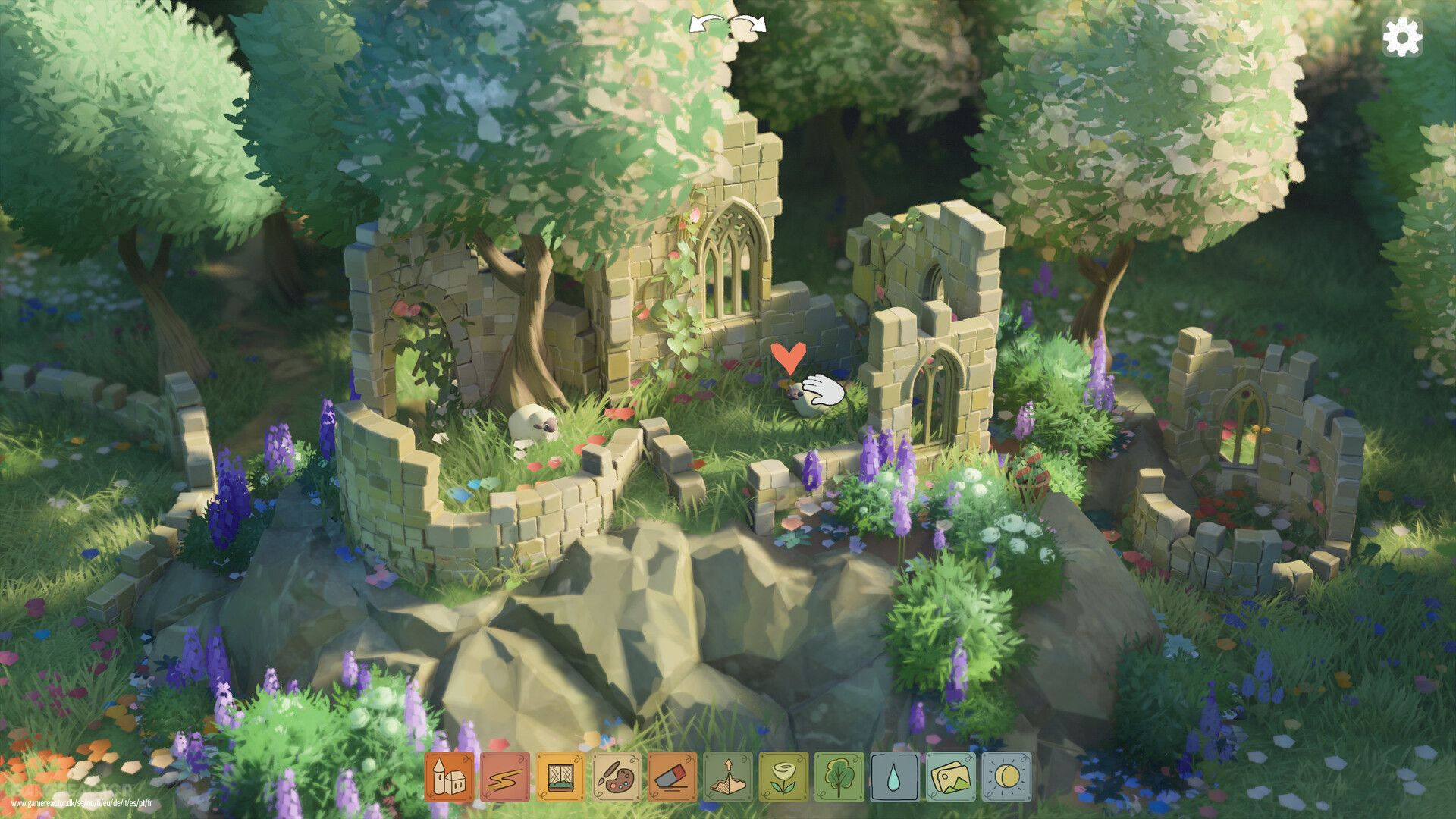
Something that’s traditionally been very common is also the digital toy. Theme parks, railroad enterprises, and life simulators, have all seen their share of success. Some haven’t had any victory conditions or even goals for the player to achieve beyond what they can figure out on their own. This is another thing only games can achieve, where systems interact and combine in pleasing or compelling ways. Games like the beautiful and technically marvellous Tiny Glade does this in a modern context, and for generations that grew up with Toca Boca, Minecraft, and many of the most popular experiences on Roblox, desire for digital toys may signify a larger part of the gamer population than we may even be aware of yet.
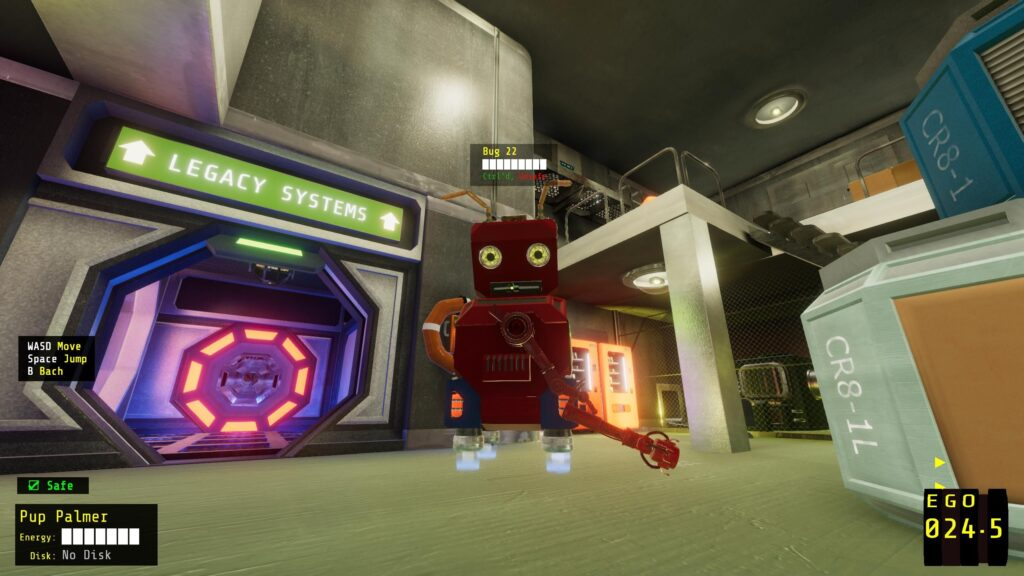
Finally, there is a growing number of independent small developers that are working on “indie imsims.” Games that borrow, concretely or in spirit, from the Looking Glass classics that Randy Smith helped develop. Some of them go for the atmosphere, while others are more philosophical in how they approach their immersive qualities. In all cases, they focus on interactivity because it’s easier to do mechanics than to compete against bigger studios in visual fidelity.
End Notes
Hopefully, you can see where I’m coming from with this post. There is so much left unexplored in the interactive space that we should take every chance we have to figure things out. Solve problems. Look for new ways to engage.
Interactivity is the unique third dimension of games. We shouldn’t be afraid of it: we should embrace it. Let players kill the princess and rescue the dragon. Let them give the ring to Gollum and retire to the Shire to start a restaurant. Let them fail or choose poorly and handle the consequences.
- Interactivity is the unique third dimension of game storytelling.
- Interaction hinges on all six elements of game feel: input, response, context, rules, polish, and metaphor.
- Interactivity requires that you get to make the important actions in the metaphor.
- Games should present a series of interesting choices.


Interactivity is not the key, it’s the elusive word ‘interesting’ we all crave. Like Alice in Wonderland who doesn’t care much for where she goes but clearly like us expects to get to somewhere interesting. Promise me meaning and purpose and that I will not fail but let me choose my own path every step of the way.
Thanks for the post, Martin. We gotta meet up and talk game design again one day soon.
We definitely should! Things should be calming down somewhat in 2025.
But I agree that meaning and interest is what makes things matter. Not the pushing of buttons or the empathetic connection, but all of the parts together and the player’s role in all of it.